On this page
Dhanmondi grew up as a planned residential district in the middle of the last century, and it still feels like one. The houses are set on numbered roads, the lake threads through the middle, and the streets are full of schools, clinics, coaching centres and cafes. It lacks the diplomatic polish of the north and the commercial weight of the south, and that is exactly what draws people who want to see ordinary city life.
The short version
- Dhanmondi is a settled residential district where you stay among families and students, not among embassies or head offices.
- Expect small and mid-range hotels and serviced flats rather than large international brands, plus good walking, cafes and cultural centres.
- It sits closer to Old Dhaka than Gulshan does, but it has no metro station of its own and is a long road trip from the airport.
- The week has a rhythm: Sunday starts the working week, Friday evening fills the lake and Saturday is slower.
The area adjoins Lalmatia and Mohammadpur to the west, Kalabagan and Panthapath to the north-east and the university quarter to the south-east. This guide explains how the district divides, who benefits from staying here, and how to get out of it. For a comparison of the whole capital, the overview of where to stay in Dhaka is the place to start.
A district wrapped around a lake
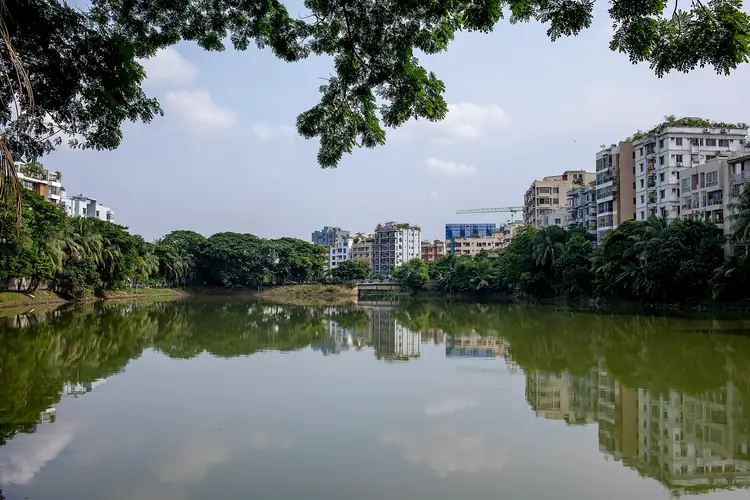
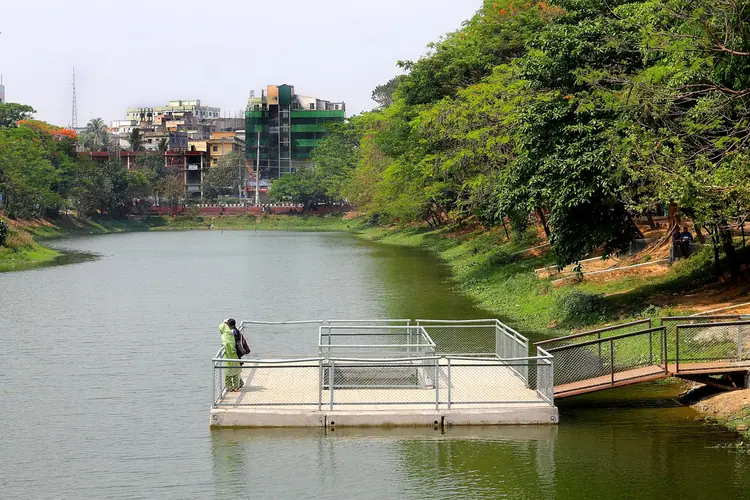
The lake is the organising feature of Dhanmondi. It winds through the district in a long, irregular shape, crossed by roads and footbridges, with walkways on its banks in many stretches. The roads around it are numbered, with lettered branches, which makes finding an address possible if you know the number and the side of the water. Taxis and rickshaw pullers, however, rely on landmarks, so give a cafe, a school or a junction when you can.
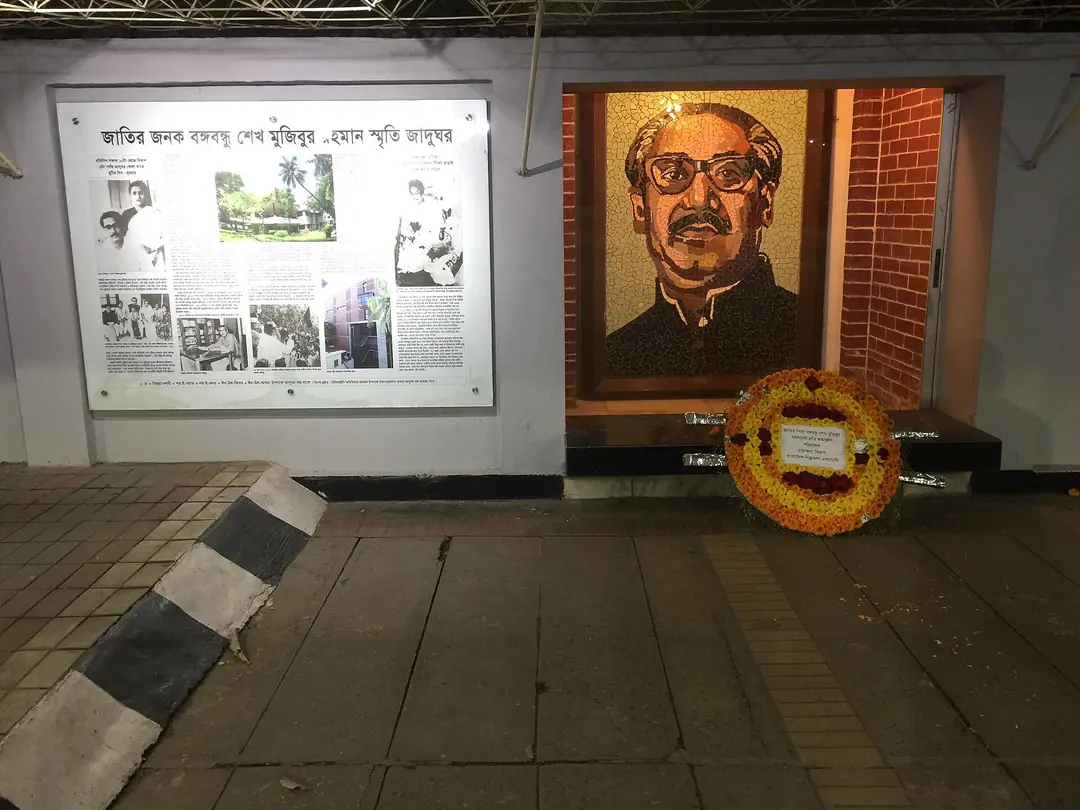
Walking here is more pleasant than in most of Dhaka. Pavements exist on the main roads, trees shade many of the side streets and the lake paths are wide enough for a morning stroll. Early risers use them for exercise, and in the evening families and couples sit on the benches. A hotel within a few minutes' walk of the lake gives you a daily routine that is hard to find elsewhere in the city.
Noise is lower than on the main avenues, though not low. Road 27 and the larger roads carry heavy traffic from morning to night, while the interior lanes are calmer. Ask any hotel which road it faces, and choose a street one step back from the avenue if you value sleep.
Culture, galleries and bookshops
Dhanmondi has long been a district for the arts. Private galleries, music and dance schools, theatre groups and cultural centres sit on its numbered roads, and rehearsals and exhibitions fill evenings and weekends. Most are modest buildings behind gates, with a notice or a banner outside, and you rarely find them by chance. Ask at your hotel or a nearby cafe, and check the opening days, because many close for one weekday.
Books are a second thread. The streets around the nearby university quarter are lined with stalls selling textbooks, second-hand paperbacks and stationery, and Nilkhet is a famous book market within an easy ride. Browsing is slow and sometimes chaotic, but you can find English titles on Bangladeshi history, poetry in translation and maps. Bargaining is normal, so keep the tone friendly.
February is the busiest cultural month. The Ekushey book fair fills the Shahbagh area, and 21 February, Shaheed Dibosh and International Mother Language Day, draws crowds to the Central Shaheed Minar. Dhanmondi is a short ride from both, which makes it a convenient base for visitors who time a trip to the festival. Book rooms early if your dates are in February.
Students, clinics and the weekly rhythm
Colleges, schools and tutoring centres give the area its daytime energy. Students fill the cafes and the lake paths after classes, and the crowd thins during exam periods and holidays. If you want to meet people, this is one of the easier parts of the capital for a conversation; some young residents speak good English and are curious about visitors.
The week has a clear pattern. Sunday is the first working day, so traffic, school runs and office queues return from early morning. Midweek is steady. On Friday, the weekend, mornings are calm, but the lake and the cafes fill from late afternoon, and the roads that were empty at breakfast become crowded by dinner. Saturday is slower again, and some shops open late.
Friday midday is the main congregational prayer, and mosques fill and spill onto the pavement. Walk around the crowd rather than through it, and expect some roads to close briefly. Outside prayer times, the district is quiet and easy to explore on foot.
Clinics and longer stays
Many visitors to Dhanmondi are not tourists at all. Hospitals and clinics line Green Road and Panthapath, between Dhanmondi and Karwan Bazar, and patients and their families come from across the country and from abroad for treatment. Guesthouses and serviced flats in Dhanmondi, Kalabagan and Lalmatia serve them, usually on weekly terms, and they are an honest option for any traveller who needs a quiet base for several days.
If you are travelling for medical care, confirm appointments and procedures directly with the provider, and read official travel and health advice before you go. A hotel can arrange a car, but it cannot assess a clinic for you. Serviced apartments with a kitchen help with diet and routine during a long stay.
For others, the same infrastructure is a benefit. Pharmacies are plentiful, doctors are close and supermarkets and laundries are within a short walk. A week or more here costs less in effort than a week in a hotel on the main roads of the north.
Getting around from Dhanmondi
Dhanmondi has no metro station of its own. MRT Line 6 runs to the east and north, and the nearest stations are Farmgate and Karwan Bazar, a short ride by car, CNG or ride-hailing. From there the line runs to Shahbagh, Dhaka University and Motijheel on the south side, or to Agargaon, Mirpur and Uttara on the north. Use the train for long hops and the road for the first and last stretch.
Mirpur Road is the main artery along the eastern edge, with buses, cars and rickshaws in a constant stream. Road 27 and the cross roads carry traffic east and west across the district. Rickshaws are barred from some of the larger roads, so a puller may take a longer route through the interior streets. Agree the fare before you start and ask him to follow the route you want.
Old Dhaka lies south-east, and the old city is closer than from Gulshan. Even so, the ride to Lalbagh or Sadarghat can take half an hour or more depending on the hour, so a plan like the Old Dhaka heritage walk works well as an early start from here. The airport is far to the north, at least an hour at busy times, so leave generous time on the day of departure.
Long-distance buses leave from the edges of the city: Kallyanpur has intercity counters and Gabtoli is the western terminal, both reached from Dhanmondi by road. For trains, Kamalapur is the main station in the south, and Biman Bandar lies by the airport. The guide to getting around Bangladesh compares the modes.
Cafes, street food and evenings
Evenings are easy in Dhanmondi. Cafes, tea stalls and small restaurants stay open late on the main roads, and the lake edge is a good place for a walk after dinner. You can sample a range of Bangladeshi snacks from street vendors, such as spiced puffed rice, fried chickpea fritters, tea and sweets, while larger restaurants serve full meals with rice, fish and curries.
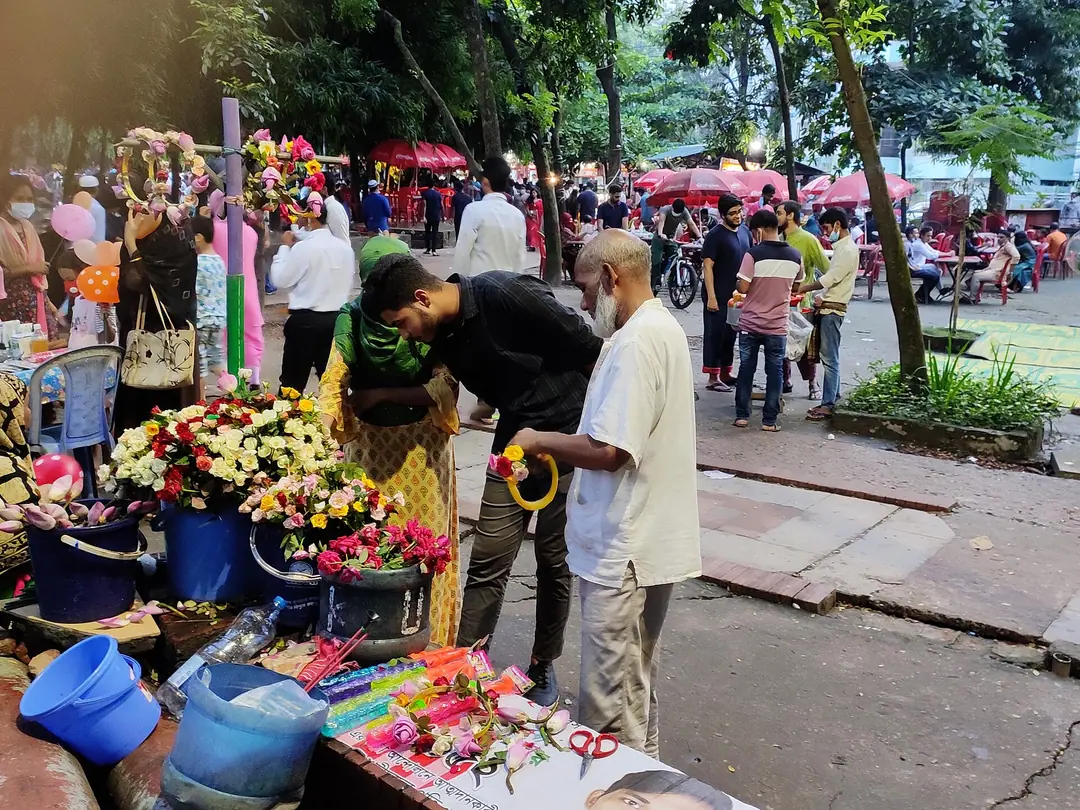
Food safety follows the usual rules. Choose stalls that are busy, eat food that is cooked in front of you, and drink bottled or filtered water. If your stomach is sensitive, begin with simple dishes and add street food gradually. The Bangladeshi food guide lists dishes to try, and your hotel can point out clean, popular places.
Seasons, Ramadan and your room
The time of year shapes a stay here. November to February is dry and cooler, and the most comfortable season for exploring on foot. April and May are hot, with sudden nor'wester storms, so ask for a room with working air conditioning and check how the building copes with power cuts. From June to September, monsoon rain can leave water standing on streets for a while. Pack quick-drying clothes and footwear that grips on wet ground. When booking, ask whether the entrance road floods and whether there is a lift, since stairs are tiring in the heat.
Ramadan also changes the daily pattern. In 2027 it is expected to start around 8 to 9 February, with Eid al-Fitr around 10 March, though both depend on the moon. Many food outlets keep different daytime hours during the fast, and the period before sunset is busy as people travel home to break it. Be discreet about eating, drinking or smoking in public during daylight. Around Eid, many businesses close and transport out of Dhaka fills early. Check opening hours with your hotel, and arrange onward tickets well ahead.
Who Dhanmondi suits, and how long to stay
The district suits travellers who want to live in a neighbourhood rather than a hotel zone. Students, writers, researchers, families visiting relatives and anyone on a long stay will find daily life easy here. It is less suited to travellers who want a swimming pool, a bar or an international brand, since the hotels are mostly small and mid-range.
| Base | Strength | Weakness | Old Dhaka |
|---|---|---|---|
| Dhanmondi | Lake, cafes, daily life, clinics | No metro, few big hotels | Moderate ride |
| Gulshan and Banani | International hotels, restaurants | Far from the old city | Long ride |
| Motijheel and Paltan | Metro terminus, banks, trains | Quiet after dark, sparse dining | Closest |
| Uttara and the airport | Flights, metro start | Far from nearly everything | Longest ride |
Two or three nights are enough for a taste of the district, and a week is easy. Use the first day to walk the lake and learn the roads, the second for a trip to the old city, and the third for the museums and the university area. Then move on, or stay and settle in.
- Early
Walk the lake in the cool hour after sunrise, then eat breakfast at a local cafe.
- Mid-morning
Take a CNG or a car to Lalbagh and the old city, and return before the afternoon rush.
- Afternoon
Browse the book stalls near the university quarter, then rest back at your hotel.
- Evening
Return to the lake at dusk, or look for an exhibition, a music evening or a rehearsal at a cultural centre.
Hotels to consider
Questions and answers
Is Dhanmondi a good area for tourists to stay?
It suits travellers who want daily life, a lake and cafes rather than a resort. Hotels are mostly small and mid-range and there is no metro station, so it is better for several days than for a one-night stop. Gulshan is easier for a first visit.
Is there a metro station in Dhanmondi?
No. MRT Line 6 runs to the east and north of the district, and the nearest stations are Farmgate and Karwan Bazar, a short ride by car, CNG or ride-hailing. From there the line runs south to Shahbagh and Motijheel and north to Mirpur and Uttara.
How far is Dhanmondi from Old Dhaka?
Old Dhaka lies south-east of Dhanmondi, and the straight-line distance to Motijheel is roughly four to six kilometres. By road the trip to Lalbagh or Sadarghat can take half an hour or more, depending on the hour, so start early and plan one destination at a time.
Can I walk around Dhanmondi Lake safely?
Many residents walk the lake paths in the morning and evening, and they are usually busy and lit near the main roads. Stay on populated stretches, avoid empty paths late at night and keep a bag in front of you. Some sections have gaps, so check the route before you start.
Which hospitals and clinics are near Dhanmondi?
Many private hospitals and clinics stand along Green Road and Panthapath, close to Dhanmondi, and more lie in Kalabagan and Mohammadpur. Services and standards vary, so confirm appointments and procedures directly with the provider, and read the official travel and health advice for Bangladesh before a medical trip.
What is Dhanmondi like on Fridays?
Friday is the weekend, so mornings in Dhanmondi are calm and the roads are lighter. Mosques fill around midday prayer, and the lake paths and cafes become crowded from late afternoon. It is a good day for a quiet walk early, and for people-watching in the evening.
How far is Dhanmondi from the airport?
The airport lies far to the north. Hotels in and near Dhanmondi are roughly nine to twelve kilometres away in a straight line, and the road trip can take an hour or more at busy times. The elevated expressway helps on some trips; ask your driver which way is working that day.
Are there international chain hotels in Dhanmondi?
The district is mainly served by small and mid-range hotels, guesthouses and serviced apartments, rather than large international brands. Those usually cluster in Gulshan, Banani and around Shahbagh and Karwan Bazar. Check the facilities list before you book, including air conditioning, a generator and breakfast.